Do you perform a QC check every time your BIM models go out of your office? If Yes, that's great! If No, ...well why not? If your company is ISO 9000 compliant then you should QC check your BIM models every time you share your BIM models with the project team.
Forget ISO 9000 for time being. One could argue that BIM Model(s) (oops!) are not contractual deliverables therefore we don't QC check them. IMHO, that's just bollocks. If you are generating most of your contractual 2D deliverables from your "For Information" BIM Model(s) then how can you afford to ignore QC checking the single source of your 2D deliverables even though you share your BIM Model(s) "For Information" only?
As you know, BIM is going to become contractual on publicly procured projects by 2016 in the UK. This means your BIM models will become part of contractual deliverables and therefore you will be required to perform QC checks every time your BIM Model goes out of the door.
So what should you be looking for when you perform a QC check? I will throw some ideas here for a starter.
First of all prepare a QC check list with two distinct categories as shown below. Now sit down with your Revit (or BIM for that matter) users and populate software specific check list and sit down with your design team (if you are lucky, your design team would be same as your Revit team) and populate design specific check list.
(1) SOFTWARE SPECIFIC QC CHECKS
(2) DESIGN SPECIFIC QC CHECKS
While you are populating your checklists, I will sit down with my BIM/Design team and populate this checklist in next couple of days and share my list with you soon. Stay tuned!
In the mean time if you have any ideas then please feel free to share with other readers by leaving your comments here.

Wednesday, 22 May 2013

Tuesday, 23 April 2013
Revit API - Skipping Unplaced Rooms
Using Revit API, if you want to collect all "Placed" rooms in a given Revit project file and want to skip all "Unplaced" rooms then use the following method.
Get "All" rooms in a project file using standard filter collector method and iterate through each room object to check the following before you add them to your final "Placed Rooms" collection.
// find the rooms, skip those rooms which are not placed but exist in a project file. Checking if Area property of room is 0.0 and location property is null.
Room tmpRoom = obj as Room;
if (null != tmpRoom.Location && Math.Round(tmpRoom.Area) != 0.0)
{
m_rooms.Add(tmpRoom);
continue;
}
The reason why I list this method here is because I used the following up until now and it worked well but for some reason it stopped working in Revit 2013 API while I was updating my plugins. When I checked using Revit snoop database..all unplaced rooms show Level property that they were last placed and deleted and show null property in object type.
// find the rooms, skip those rooms which don't locate at Level yet.
Room tmpRoom = obj as Room;
if (null != tmpRoom && null != tmpRoom.Level)
{
m_rooms.Add(tmpRoom);
continue;
}
Get "All" rooms in a project file using standard filter collector method and iterate through each room object to check the following before you add them to your final "Placed Rooms" collection.
// find the rooms, skip those rooms which are not placed but exist in a project file. Checking if Area property of room is 0.0 and location property is null.
Room tmpRoom = obj as Room;
if (null != tmpRoom.Location && Math.Round(tmpRoom.Area) != 0.0)
{
m_rooms.Add(tmpRoom);
continue;
}
The reason why I list this method here is because I used the following up until now and it worked well but for some reason it stopped working in Revit 2013 API while I was updating my plugins. When I checked using Revit snoop database..all unplaced rooms show Level property that they were last placed and deleted and show null property in object type.
// find the rooms, skip those rooms which don't locate at Level yet.
Room tmpRoom = obj as Room;
if (null != tmpRoom && null != tmpRoom.Level)
{
m_rooms.Add(tmpRoom);
continue;
}
Friday, 12 April 2013
@UniWestminster @UoWBECi Open Lecture on BIM
Recently, I was invited to deliver open lecture on BIM at the University of Westminster. The brief was to start from BIM What, Why, Benefits and then cover where the UK industry is in terms of BIM, role students have to play and some references.
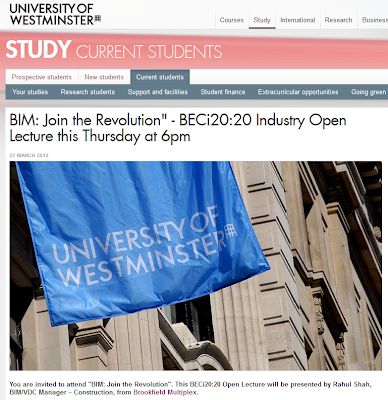
Here is a link to my presentation video. As usual, there is no audio so no need to put on your headphones! Hope you enjoy this and find it somewhat useful for you.
Disclaimer: The content of this video is not suitable for any person over (x) years of BIM experience. If you fall under this category and ignore this disclaimer and hit the play button then the author does not take any responsibility of loss of...well, your time!
Here is a link to my presentation video. As usual, there is no audio so no need to put on your headphones! Hope you enjoy this and find it somewhat useful for you.
Disclaimer: The content of this video is not suitable for any person over (x) years of BIM experience. If you fall under this category and ignore this disclaimer and hit the play button then the author does not take any responsibility of loss of...well, your time!
Msc BIM Management
It is official now! No, not just the course itself. Some of you would have already heard about this course (that I am going to mention below) but what is official is "BIM Management" as oppose to "Information Management". Ok, this should be enough to provoke your thoughts on lovely Friday afternoon.
Middlesex University has launched a brand new course called MSC in BIM Management, starting from Oct2013. It is a part-time distance learning course so you can do this while you are doing your day job of Information Management!-;)
I think this is the first BIM course that focuses mainly on management of BIM whereas other courses out there in the UK are more either mixed bag of BIM/Design Management/Construction Management etc or not touching upon management aspect of BIM at all.
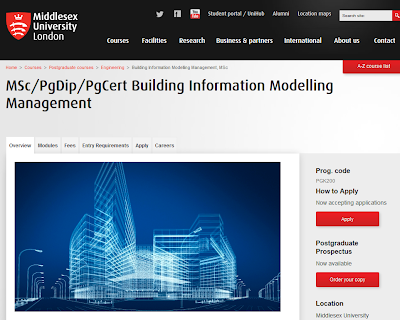
"BIM is a process involving the structured sharing and coordination of digital information about a building project throughout its entire lifecycle, from design through procurement and construction and beyond, into the operation and management stage, all the way through to demolishment.
As a direct response to this industry need, we have developed this course which aims to produce practitioners with a qualification to be BIM enabled in their discipline with a critical awareness of contemporary BIM issues informed by technology, research and management skills in standard and unpredictable scenarios.
Importantly, the course provides practitioners in the property and construction sector, and related stakeholders providing services for it, with a qualification to be employed in a management role in BIM projects. These include technical BIM management positions, operational/administrative BIM management positions, and strategic BIM management positions."
Middlesex University has launched a brand new course called MSC in BIM Management, starting from Oct2013. It is a part-time distance learning course so you can do this while you are doing your day job of Information Management!-;)
I think this is the first BIM course that focuses mainly on management of BIM whereas other courses out there in the UK are more either mixed bag of BIM/Design Management/Construction Management etc or not touching upon management aspect of BIM at all.
"BIM is a process involving the structured sharing and coordination of digital information about a building project throughout its entire lifecycle, from design through procurement and construction and beyond, into the operation and management stage, all the way through to demolishment.
As a direct response to this industry need, we have developed this course which aims to produce practitioners with a qualification to be BIM enabled in their discipline with a critical awareness of contemporary BIM issues informed by technology, research and management skills in standard and unpredictable scenarios.
Importantly, the course provides practitioners in the property and construction sector, and related stakeholders providing services for it, with a qualification to be employed in a management role in BIM projects. These include technical BIM management positions, operational/administrative BIM management positions, and strategic BIM management positions."
Thursday, 11 April 2013
£20k for Innovative Ideas
No! My BIM friends, this is not for 'BIM' innovative ideas and not for practitioners in the industry. However, I wish someone (you know who I mean from UK perspective) extends this idea to 'BIM' and
introduces prize for innovative ideas in BIM adoption. BIM technology is already innovative, well kind of, but what we need to be innovative is in BIM's implementation, engagement at all levels and collaboration. So, the proposed prize for BIM could be called:
"The UK Government's 2016 BIM Prize, looking for innovative ideas from UK students to help the UK Construction industry adopt Level 3 BIM by 70% by 2025"
For now, The mayor of London has launched "The 2013 Mayor's Low Carbon Prize" in partnership with Seimens for students in London.
"Climate change is the biggest threat to our future and poses a huge challenge for London. That's why we must act now to reduce our emissions and adapt to the changes climate change will bring.
The 2013 Mayor's Low Carbon Prize, in partnership with Siemens, is looking for innovative ideas from London's students to help us slash London's CO2 emissions by 60 per cent by 2025."
Read full article HERE.
"The UK Government's 2016 BIM Prize, looking for innovative ideas from UK students to help the UK Construction industry adopt Level 3 BIM by 70% by 2025"
For now, The mayor of London has launched "The 2013 Mayor's Low Carbon Prize" in partnership with Seimens for students in London.
"Climate change is the biggest threat to our future and poses a huge challenge for London. That's why we must act now to reduce our emissions and adapt to the changes climate change will bring.
The 2013 Mayor's Low Carbon Prize, in partnership with Siemens, is looking for innovative ideas from London's students to help us slash London's CO2 emissions by 60 per cent by 2025."
 |
| Image Courtesy: www.london.gov.uk |
Friday, 5 April 2013
4D BIM Case Study
I have been swamped with so many new/exciting things in my work life since I joined my new employer that I hardly get time to share my BIM thoughts with the community. But the good news is that those busy days are over so you should get regular BIM commentary from me.
Some exciting stuff is coming (including some Revit BOLT-ONS that I was planning to release in Dec 2012) but today I am going to start with my last week's BIM experience.
I was fortunate to attend the first ever RICS BIM Conference in Scotland on 26th March 2013. The event was a smaller version of RICS BIM National event held in February 2013 in London but the values/objectives were similar to that of any other UK BIM event; that is to raise awareness, learn from project BIM experiences and build your BIM network in Scotland region.
We presented our 4D BIM case study on the largest hospital project on site in the UK, New South Glasgow Hospital. This BIM case study is one of the many lonely/partial BIM case studies out there where project participants used "Lonely BIM" for their own benefits. The whole day was full of collaborative BIM talks so it was kind of a change! for the audience to see how "Lonely BIM" could benefit on such a large project.
Here is the full presentation in a video mode for your reference. Apology for no audio in the movie.
Hope you enjoy and learn something from it. As usual, feel free to drop your comments.
Some exciting stuff is coming (including some Revit BOLT-ONS that I was planning to release in Dec 2012) but today I am going to start with my last week's BIM experience.
I was fortunate to attend the first ever RICS BIM Conference in Scotland on 26th March 2013. The event was a smaller version of RICS BIM National event held in February 2013 in London but the values/objectives were similar to that of any other UK BIM event; that is to raise awareness, learn from project BIM experiences and build your BIM network in Scotland region.
We presented our 4D BIM case study on the largest hospital project on site in the UK, New South Glasgow Hospital. This BIM case study is one of the many lonely/partial BIM case studies out there where project participants used "Lonely BIM" for their own benefits. The whole day was full of collaborative BIM talks so it was kind of a change! for the audience to see how "Lonely BIM" could benefit on such a large project.
 |
| Image Courtesy: http://www.nhsggc.org.uk |
Here is the full presentation in a video mode for your reference. Apology for no audio in the movie.
Hope you enjoy and learn something from it. As usual, feel free to drop your comments.
Wednesday, 27 February 2013
C3 for Project BIM Success
Recently, I was asked to advise on "Design BIM" setup for a large tower project with the team dispersed in different geographical regions. I spent some time establishing BEP, Model break down, BIM resourcing and the like. During my time with them, one of the team members asked me for some tips on successful BIM management on that project.
My advise to him was C3. Having robust BEP and other protocols and procedures setup is a first step toward successful BIM implementation on a project. But what sits above all is this C3. I advised them to focus on the C3.
Here what C3 looks like.

COMMUNICATION
Communication is the first ingredient for BIM success on any project. So what should you communicate? Basically everything that you do in your 'BIM' model (oops!) that affects a person sitting next to you should be communicated. For instance, in Revit world, simple things like tidying up project browser and filing views under appropriate folders, introducing new workset or migrating objects on appropriate workset, areas in abeyance, key changes in model elements, introducing new method of doing something, deviating from family/type naming convention etc. The list could go on and on. Also, decide protocols for internal communication and external communication; i.e. what, when and how for internal communication will be different to external communication. Establish some basic communication protocols and "communicate" that to the entire team in a clear manner.
CONSISTENCY
Consistency is the next ingredient for BIM success, specially on a large project with disperse teams and multiple users. When I was managing "Design BIM" side of things in my previous roles, I used to tell my users that focus on consistency and not what is right or wrong. Nothing is right or wrong, at least in BIM world. Agree a method and stick with it. Consistently 'wrong' can be rectified quicker than a mixed bag. The reason why I used to insist this to my teams is because many times a "User A" would come to me and say look! I have found a sophisticated way of doing 'something' so I think we should model in this way. Next is "User B" who finds another way of doing that 'something' and he/she thinks we should approach modelling that way. Now as a BIM Manager my focus shifts from BIM management to people's management, you know what I mean! To avoid that I used to tell my users that focus on consistency so that we can achieve efficiency in what we do. Sophistication can be achieved later.
COMMITMENT
Commitment is the third and last ingredient for BIM success, specially on a large project with disperse teams and multiple users. You need commitment from all users so that they communicate as per established protocol and maintain consistency throughout the project.
If you manage to achieve C3 on your project then BIM success on your project is virtually guarenteed.
My advise to him was C3. Having robust BEP and other protocols and procedures setup is a first step toward successful BIM implementation on a project. But what sits above all is this C3. I advised them to focus on the C3.
Here what C3 looks like.

COMMUNICATION
Communication is the first ingredient for BIM success on any project. So what should you communicate? Basically everything that you do in your 'BIM' model (oops!) that affects a person sitting next to you should be communicated. For instance, in Revit world, simple things like tidying up project browser and filing views under appropriate folders, introducing new workset or migrating objects on appropriate workset, areas in abeyance, key changes in model elements, introducing new method of doing something, deviating from family/type naming convention etc. The list could go on and on. Also, decide protocols for internal communication and external communication; i.e. what, when and how for internal communication will be different to external communication. Establish some basic communication protocols and "communicate" that to the entire team in a clear manner.
CONSISTENCY
Consistency is the next ingredient for BIM success, specially on a large project with disperse teams and multiple users. When I was managing "Design BIM" side of things in my previous roles, I used to tell my users that focus on consistency and not what is right or wrong. Nothing is right or wrong, at least in BIM world. Agree a method and stick with it. Consistently 'wrong' can be rectified quicker than a mixed bag. The reason why I used to insist this to my teams is because many times a "User A" would come to me and say look! I have found a sophisticated way of doing 'something' so I think we should model in this way. Next is "User B" who finds another way of doing that 'something' and he/she thinks we should approach modelling that way. Now as a BIM Manager my focus shifts from BIM management to people's management, you know what I mean! To avoid that I used to tell my users that focus on consistency so that we can achieve efficiency in what we do. Sophistication can be achieved later.
COMMITMENT
Commitment is the third and last ingredient for BIM success, specially on a large project with disperse teams and multiple users. You need commitment from all users so that they communicate as per established protocol and maintain consistency throughout the project.
If you manage to achieve C3 on your project then BIM success on your project is virtually guarenteed.
Subscribe to:
Posts (Atom)